Riverhead homeowners aren't waiting for a backup to act. Here's why cesspool installation is surging across Suffolk County — and what smart timing can save you.
If your Riverhead home still has the same cesspool it had twenty or thirty years ago, you’re not alone. Most of Suffolk County is in the same situation. But something has changed in the last few years — and it’s not just aging infrastructure. New regulations, a county-wide water quality crisis, and a grant program that can cover up to 75% of installation costs have quietly turned cesspool installation from a crisis response into one of the smarter financial moves a homeowner can make. This page explains what’s behind that shift, what the process actually involves, and what you should know before you call anyone.
Riverhead sits at the fork of Long Island — where the North Fork wine country begins and the Peconic River empties into Peconic Bay. It’s a community with deep agricultural roots, a mix of older residential neighborhoods and newer development, and a water supply that depends entirely on what’s happening underground. That last part matters more than most homeowners realize.
Suffolk County gets 100% of its drinking water from underground aquifers. There are no rivers or reservoirs to fall back on. And roughly 74% of homes in the county — including most in Riverhead — are not connected to public sewers. That means what goes into your cesspool eventually reaches the same groundwater your family drinks. When you understand that, the urgency behind the county’s recent push to upgrade aging systems starts to make a lot more sense.

In July 2019, Suffolk County changed the rules. Traditional cesspool-only replacements are no longer permitted. If your system needs to be replaced — whether because it failed, because you’re renovating, or because a home inspector flagged it — you can’t simply swap in what you had before. At minimum, any new installation must include a septic tank. In many cases, particularly in environmentally sensitive areas or on properties near waterways like the Peconic River, a full nitrogen-reducing system is required.
These systems are called I/A OWTS — Innovative and Alternative Onsite Wastewater Treatment Systems. They reduce nitrogen discharge by 70 to 90 percent compared to a conventional cesspool. That’s a significant difference when you consider that conventional cesspools release roughly 40 pounds of nitrogen per household into the ground every year, and that nitrogen from residential systems accounts for approximately 64% of the total nitrogen reaching Suffolk County’s groundwater.
Here’s what surprises most homeowners: an estimated 252,530 homes across Suffolk County still have pre-regulation cesspool-only systems. Many of those systems were installed 40, 50, or 60 years ago. They’re aging, they’re not built to current standards, and when they fail — and eventually they do — the homeowner discovers mid-crisis that the replacement rules have changed. That’s not a great moment to be learning this for the first time.
The homeowners who are ahead of this aren’t waiting for a backup or a failed inspection. They’re making the decision on their own timeline, which means they can plan, apply for grants, and choose their contractor carefully rather than calling whoever picks up the phone on a Saturday morning.
Cost is the number one reason homeowners put off cesspool installation. That’s understandable. A qualifying nitrogen-reducing I/A OWTS system can cost $19,200 to $25,000 or more before engineering and design. For most families, that’s not a casual expense.
But here’s what’s changed: New York State recently raised its reimbursement rate for qualifying nitrogen-reducing systems to 75%, up to $25,000. On top of that, the Suffolk County Septic Improvement Program — known as the SIP — offers additional grant funding, and combined, eligible homeowners can receive up to $30,000 or more in financial assistance depending on their situation. And the IRS has confirmed, in Announcement 2022-26, that these payments are not included in your gross income. The grant money is tax-free.
That changes the math considerably. A system that costs $22,000 before grants could end up costing a fraction of that out of pocket — if you qualify and if you apply. The catch is that SIP grants are first-come, first-served. When a funding round closes, it closes. Homeowners who move while funding is available get the benefit. Homeowners who wait until their system fails often find themselves scrambling without the time to navigate the application process properly.
The grant application process itself is not simple. It involves documentation, coordination with the Suffolk County Department of Health Services, and an understanding of which systems qualify. We handle all of that paperwork as part of the installation process. We know what SCDHS requires, we know which systems are on the approved list, and we know how to maximize what you’re eligible for. That’s not something every contractor offers — and it makes a real difference in what you end up paying.
Want live answers?
Connect with a AAA Dependable Cesspool expert for fast, friendly support.
If you’ve never had a cesspool installed, the process can feel opaque. You call a company, they dig up your yard, something goes in the ground, and you get a bill. The reality is more involved — and when it’s done right, more reassuring.
A proper installation in Suffolk County starts long before anyone picks up a shovel. It begins with a site evaluation, soil percolation testing, and the preparation of engineered plans that meet SCDHS requirements. Those plans get submitted for a permit, and work doesn’t begin until the permit is approved. Skipping that step — or hiring someone who does — is how homeowners end up with failed inspections, fines, and installations they have to redo at their own expense.
Suffolk County’s soil is predominantly coarse and sandy — a product of the glacial deposits that formed Long Island thousands of years ago. That sandy composition drains quickly, which sounds like a good thing until you realize what it means for wastewater treatment. Fast-draining soil gives contaminants — including nitrogen — a short path to the water table with very little natural filtration along the way.
In many parts of Riverhead and across Suffolk County, the water table sits just a few feet below the surface. Near low-lying areas, waterways like the Peconic River, and the bays, that depth is even shallower. This isn’t a detail that a contractor from outside the region is likely to account for correctly. It affects system sizing, installation depth, and which system types are appropriate for a given property.
This is one of the reasons local knowledge genuinely matters in this industry. A contractor who installs systems across the state and occasionally handles Long Island jobs is working with a different set of assumptions than someone who has been doing this work in Suffolk County for 25 years. The soil conditions here, the water table proximity, the SCDHS requirements, the approved system list — these are things you learn by doing this work here, repeatedly, over time. We’ve been doing exactly that since 1998.
The percolation test — the soil test that determines how quickly water drains through the ground at your specific property — is a required step in the SCDHS permit process. Its results directly influence the size and type of system that gets installed. Getting that test done correctly, and interpreting it in the context of Suffolk County’s specific requirements, is part of what separates an installation that passes inspection from one that doesn’t.
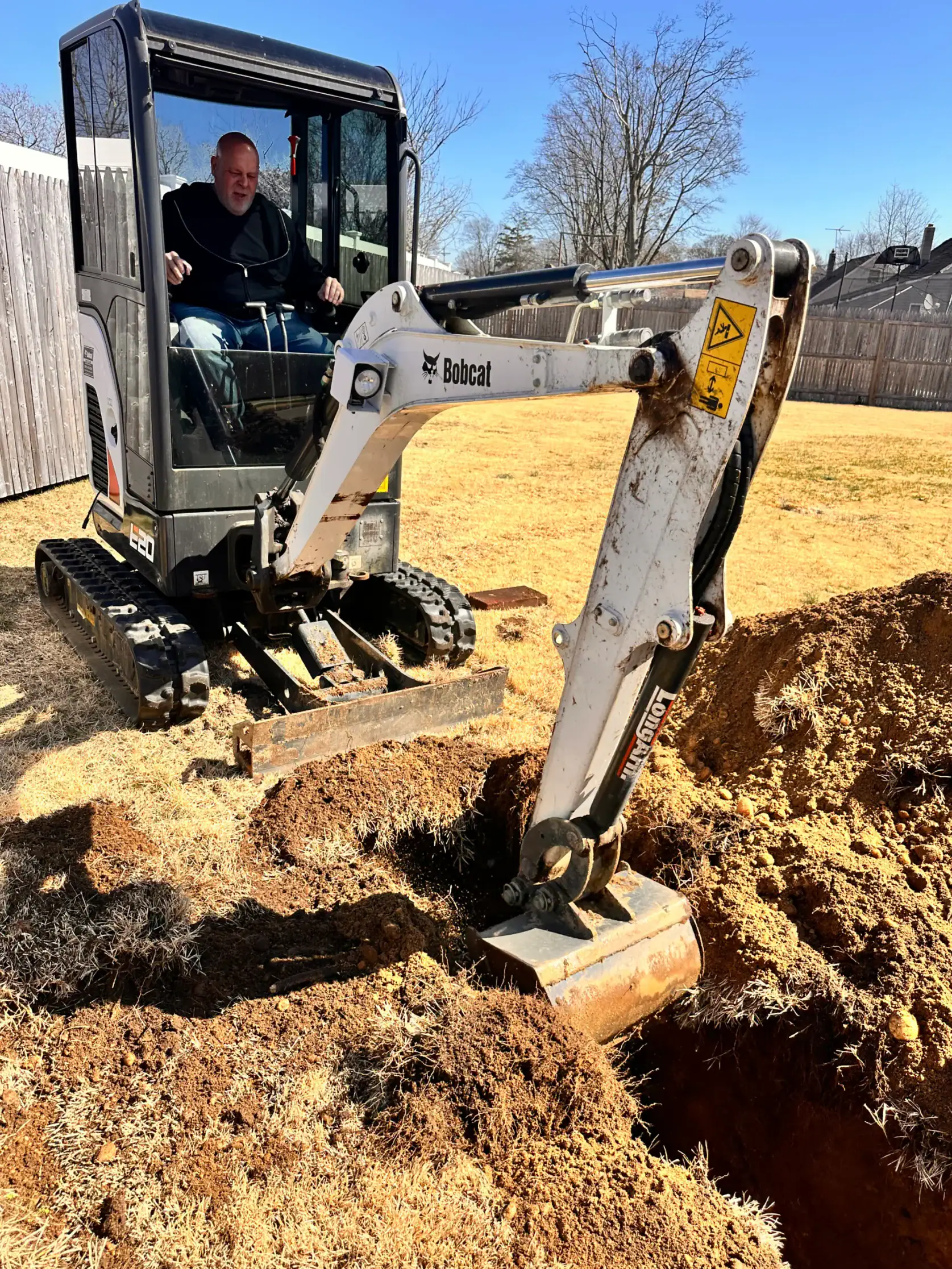
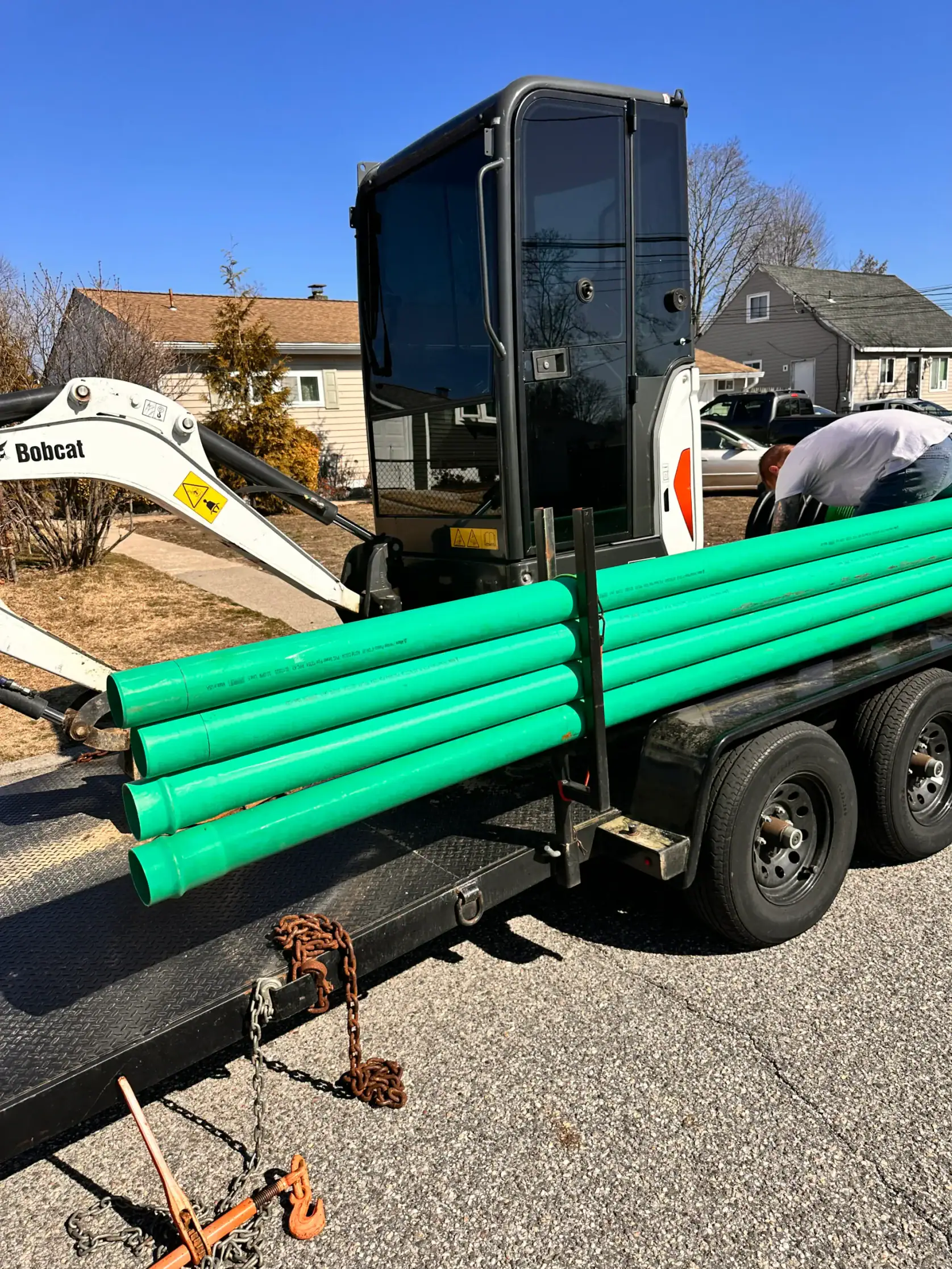
Once the site evaluation and soil testing are complete and engineered plans have been approved by SCDHS, the physical installation can begin. Excavation comes first — heavy equipment is involved, and yes, there will be some disruption to the yard. We’re upfront about that. What we can also tell you, based on what our customers consistently say after the job is done, is that we leave the property clean.
After excavation, the tank or system components are placed, connected to your existing plumbing, and properly packed and graded. For I/A OWTS systems, there are additional components — treatment units, aeration systems, or other technology depending on the specific model — that require careful installation and calibration. SCDHS conducts inspections at multiple stages: typically at excavation, at tank placement, and before backfill. We coordinate all of those inspections so you don’t have to manage that process yourself.
Once the final inspection is passed and the county signs off, the installation is complete. But for I/A OWTS systems, there’s one more thing to know: these systems require an annual service contract to remain compliant with SCDHS requirements and to keep your grant eligibility intact. Those contracts typically run $300 to $500 per year and cover the maintenance inspections and reporting that the county requires. We offer maintenance programs that cover exactly this — so the ongoing compliance piece doesn’t fall through the cracks after the installation is done.
The entire process, from initial site evaluation to final county sign-off, typically takes several weeks when permits are moving normally. Real estate-triggered installations, where a buyer or seller is under time pressure from a transaction, can sometimes be expedited — but the permit process has its own timeline, and no reputable contractor can promise to bypass it. What we can promise is that we move as efficiently as the process allows, and we keep you informed at every step.
There’s no shortage of cesspool contractors in Suffolk County. What’s harder to find is one that handles the permits, navigates the grant applications, knows the local soil conditions, and tells you what you’ll pay before the work begins — without adding charges once they’re on your property.
We’ve been doing this work in Suffolk County since 1998. Three generations. More than 325 verified five-star reviews across Google and Angi. A team that shows up when we say we will, charges what we quoted, and never recommends work you don’t need. That last part isn’t just a claim — it’s something our customers mention by name in their reviews, because it’s genuinely rare in this industry.
If you’re a Riverhead homeowner with an aging system, if you’re planning a renovation, or if you simply want to understand your options before something forces the decision — reach out to AAA Dependable Cesspool Sewer & Drain. A free estimate is a good place to start.
Summary:
Article details:
Share: